When the car won't start, it might be the key
Before you replace the battery or the starter, find out whether the car still recognizes your key.
October 6, 2026 · 4 min read
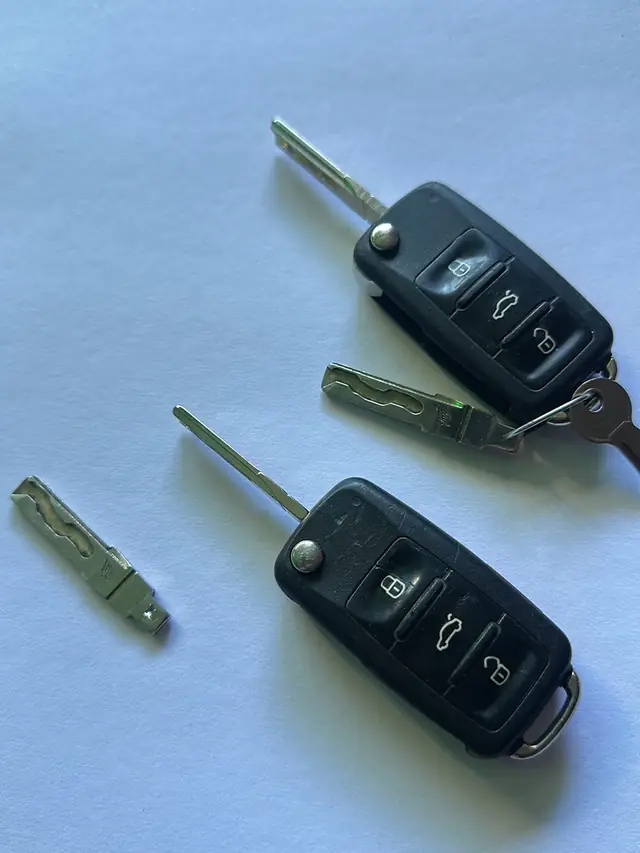
When a car won't start, most of us blame the battery, and that's a fair first guess. But plenty of cars built in the last twenty-five years have a second lock hidden inside the ignition system. When that lock stops recognizing your key, the engine won't run no matter how strong the battery is. Sometimes the problem really is the key, even when the key looks perfectly fine.
What's inside a modern car key
Most car keys made since the late 1990s carry a transponder chip. It's a tiny capsule sealed into the plastic head of the key, and it doesn't need a battery of its own. When you turn the key or press the start button, the car sends out a weak signal and the chip answers with a code. If the car's immobilizer recognizes that code, the engine is allowed to run. If it doesn't, the engine may crank and quit after a second or two, or it may not crank at all. Often a little security light on the dash blinks at you.
That's the whole idea of the system. A thief can copy the metal cut of your key, but without the right chip giving the right answer, the car stays asleep. It also means a key can look perfect, slide into the ignition, turn smoothly, and still be useless.
Why a fob bought online often won't program
Replacement fobs are easy to find online and hard to judge from a photo. A fob that looks identical to yours can use a different chip, a different frequency, or a different programming method for your exact car. Some are used fobs that were already locked to another vehicle. Some just have weak electronics inside. When you bring one of those to a locksmith, the machine can cut the blade all day, but the car has to accept the fob, and it won't accept something it can't talk to.
That doesn't mean programming is magic. It means the part has to match the car before the work starts. A good locksmith will tell you honestly whether the fob in your hand has a chance, and what a different one would take.
A 2005 fob that only needed a new contact pad
A customer was helping a close family friend whose 2005 vehicle needed a replacement fob. She had bought one online, and he took the fob and her car to Yakima Lock & Safe to see if it could be programmed. Danny, the locksmith who helped them, took the time to explain why the purchased fob wasn't working, and he tried several times to program it. Then he turned to the original fob. Its rubber button pad had worn out, so he replaced it with a pad that had new contacts on the back. That fob programmed. The customer left with a working fob and a clear explanation of what had gone wrong.
The lesson is that worn buttons aren't always a dead fob. On older remotes the little contacts under the rubber pad wear through, and the fix can be one small part instead of a whole new remote.
The 2011 Jetta that wouldn't recognize its key
Another customer had a 2011 VW Jetta with trouble in the ignition switch assembly. He replaced the assembly himself, but the car still had immobilizer problems. In the end he dragged it to the shop on a tow strap. The shop talked him through what he could do and his cost options, and he left with two working fobs and two keys that open the doors. His review says he appreciated the communication and the quick work.
On many cars, swapping an ignition part doesn't automatically tell the car's computer which keys belong to it. The immobilizer and the keys have to be introduced to each other, and that takes the right equipment and a locksmith who knows what he's looking at.
What a locksmith checks before cutting anything
Before a blade gets cut or a chip gets programmed, a careful locksmith works through a short list.
- Whether the car has a transponder system at all, and which kind, based on the make, model and year.
- Whether the key you have is complete, with its chip intact and its head not cracked or repaired.
- What the dash security light does when you turn the key: blinking, steady or dark. Each one tells a different story.
- Whether the key turns the ignition easily, since a worn key or a worn ignition cylinder can pass for an electronic problem.
- Whether a working key still exists, which usually makes copying simpler than starting from nothing.
- Whether the replacement fob you bought is the right type, before anyone tries to program it.
On the car side, Yakima Lock & Safe lists duplicate keys, making original keys, factory and aftermarket remotes, broken key removal, and replacing automotive locks and ignitions. It also cuts VATS keys, the resistor-based system found on some older GM vehicles.
What to bring when you call
A few minutes of preparation saves a lot of back and forth.
- The year, make and model of the car.
- What the dash lights do when you turn the key.
- Any spare key, even a worn one.
- Any fob you ordered online, in its packaging if you still have it.
- A note about recent work on the ignition, the battery or the starter.
If your car won't start and you suspect the key, call Yakima Lock & Safe at (509) 248-1124, or bring the car or the keys by the shop at 715 W Nob Hill Blvd and talk it through at the counter.
Yakima Lock & Safe, (509) 248-1124
Call (509) 248-1124More articles
Rekey or replace the locks after you move into a Yakima home
Nobody can tell you how many copies of the old keys are still out there, so deal with it before you unpack.
Master key systems and exit hardware for small businesses
A small business collects keys without trying, and a plan on paper fixes more than a pile of new locks.